

AI traffic is flooding websites from Google’s new AI Overviews, but does it actually convert? Here’s what the latest Google SERP updates mean for your conversion rates and what you need to know right now.
Google just changed how search works. AI Overviews now appear at the top of search results, answering questions before people even click on websites. This means AI traffic is hitting your site differently than traditional organic search traffic ever did.
But here’s the question everybody is asking: does AI traffic actually convert? Early data is showing something interesting. AI traffic behaves differently from regular search traffic, and if you’re not paying attention, you might be celebrating clicks that never turn into customers.
In this guide, we’ll break down what AI traffic really is, how Google’s latest SERP updates are changing where your clicks come from, what the data says about AI traffic conversions compared to organic traffic, and practical steps you can take right now to optimize for both.
If you’re running a website, doing SEO, or managing digital marketing, understanding AI traffic isn’t optional anymore.
Now let’s get started.
Table of Contents
Jumpstart Your Career with Pregrad Online Program
Begin your career with Pregrad online programs in trending domains like Artificial Intelligence, Machine Learning, Data Science, Digital Marketing, and plenty of others. At Pregrad, we offer students with self paced programs and regular live sessions throughout the year.
| Course Name | Mode | Link |
|---|---|---|
| Artificial Intelligence & Machine Learning | Hybrid format | https://www.pregrad.in/courses/artificial-intelligence-machine-learning |
| Data Science & Analytics | Hybrid format | https://www.pregrad.in/courses/data-science-and-analytics |
| Business Analytics | Hybrid format | https://www.pregrad.in/courses/business-analytics |
| Full Stack Development | Hybrid format | https://www.pregrad.in/courses/full-stack-development |
| Digital Marketing | Hybrid format | https://www.pregrad.in/courses/digital-marketing |
| DSA with C/C++ | Hybrid format | https://www.pregrad.in/courses/dsa-with-c |
| Python Advance | Hybrid format | https://www.pregrad.in/courses/python-advance |
| Finance Advance | Hybrid format | https://www.pregrad.in/courses/finance-advance |
| Cyber Security | Hybrid format | https://www.pregrad.in/courses/cyber-security |
What Is AI Traffic and How Does It Work?
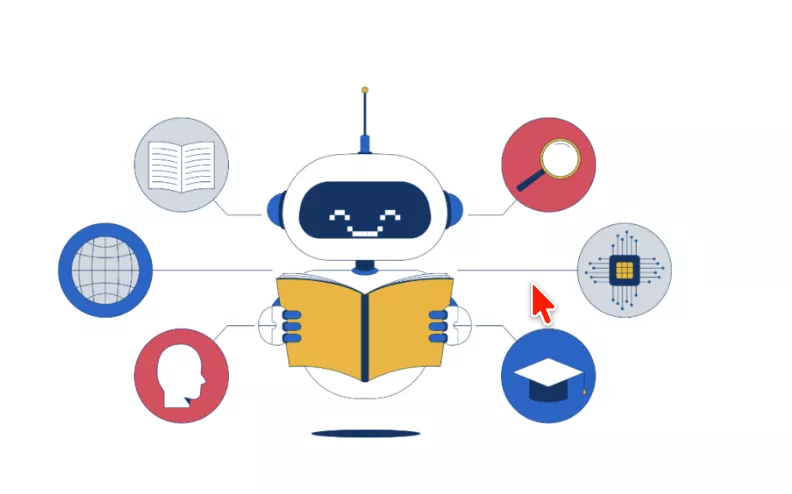
AI traffic is website traffic that comes from Google’s AI-powered search features. Specifically, from AI Overviews that now appear at the top of many search results.
Here’s how it works. When someone searches on Google, they often see an AI-generated summary before the traditional blue links. This AI Overview pulls information from multiple sources and presents it directly in the search results. If your website is cited in that AI Overview, users can click through to your site. That click is AI traffic.
This is what Sundar Pichai, CEO of Google has to say;

This is different from traditional organic traffic. With organic traffic, people see your page title and description in search results, then decide to click. With AI traffic, Google’s AI has already summarized information from your page. Users clicking through have already seen a preview of your content.
The AI Overview feature rolled out widely in 2024 and expanded significantly in 2025. Google calls it Search Generative Experience or SGE in some documentation. But most people just call it AI Overviews.
AI traffic comes from users who interact with these AI-generated summaries. They might click a source link, explore related questions, or dig deeper after reading the overview. The behavior is fundamentally different from someone who just sees your listing and clicks.
Google’s algorithm decides which websites get cited in AI Overviews. It pulls from sources it considers authoritative and relevant. If your content is featured, you get AI traffic. If it’s not, you don’t.
The key difference is intent. Someone clicking from a traditional search result is looking for information. Someone clicking from an AI Overview has already gotten some information. They’re coming to your site for a different reason, usually for more depth, verification, or to take action.
This changes everything about conversion rates. Understanding what AI traffic is helps you see why it might convert differently than the organic traffic you’re used to.
Read More: 7 Best ChatGPT Alternatives in 2026 (Free & Paid Options Available)
AI Traffic vs Organic Traffic: How Conversion Rates Compare
This is what Juan C. Terán-Vela, said on LinkedIn about Ai traffic conversion:
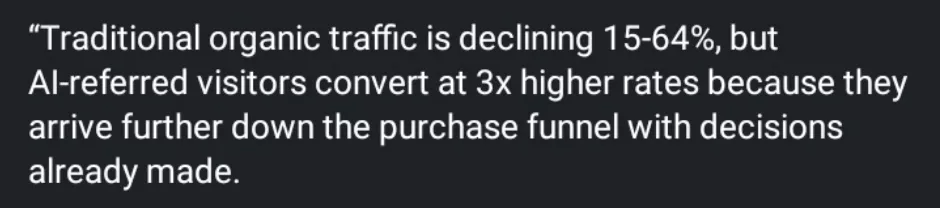
AI traffic and organic traffic come from the same place, Google search results. But they don’t behave the same way when it comes to conversions.
Let’s start with what we know about organic traffic. When someone clicks your listing from traditional search results, they’re actively seeking information. They read your title, your meta description, and decided your page might have what they need. The intent is clear. They want something, and they think you have it.
AI traffic works differently. These users have already seen a summary of information in the AI Overview. Google’s AI has answered part of their question before they even reach your site. So when they click through, they’re not starting from zero. They’re coming with context.
Early data from marketers and SEO professionals shows mixed results. Some websites are seeing AI traffic convert at lower rates than organic traffic. Others are seeing similar or even better conversion rates. The difference comes down to what type of content you have and what action you want visitors to take.
Here’s what the data is showing so far. Informational content tends to get lower conversions from AI traffic. Why? Because the AI Overview already gave users the answer they needed.
If someone searches “how to reset an iPhone” and the AI Overview walks them through it, they might not need to visit your detailed guide. If they do click, they’re probably looking for edge cases or troubleshooting, not the basic steps.
Transactional content shows different results. Product pages, service offerings, and commercial content can actually see decent conversions from AI traffic. The AI Overview might introduce your product or service, but users still need to visit your site to make a purchase, get pricing details, or sign up.
Comparison content sits somewhere in between. If your page compares products or services, the AI Overview might summarize key points. But users researching purchases often want to read full comparisons themselves before deciding. This means AI traffic to comparison pages can still convert well.
The conversion rate gap varies by industry. E-commerce sites report AI traffic converting at roughly 60-75% the rate of organic traffic. SaaS and B2B sites see AI traffic converting at 50-80% compared to organic. Content sites and blogs see the biggest drop, with AI traffic converting at 30-50% of organic traffic rates.
But here’s what matters more than the numbers. The quality of AI traffic depends on where users are in their journey. If the AI Overview fully answers their question, only highly motivated users click through. That smaller group might actually convert better because they’re further along in the decision process.
Read More: Free AI Video Generator with ChatGPT 2026: Can I Make AI Video with ChatGPT?
Google’s Latest SERP Changes: What’s New with AI Overviews in 2026
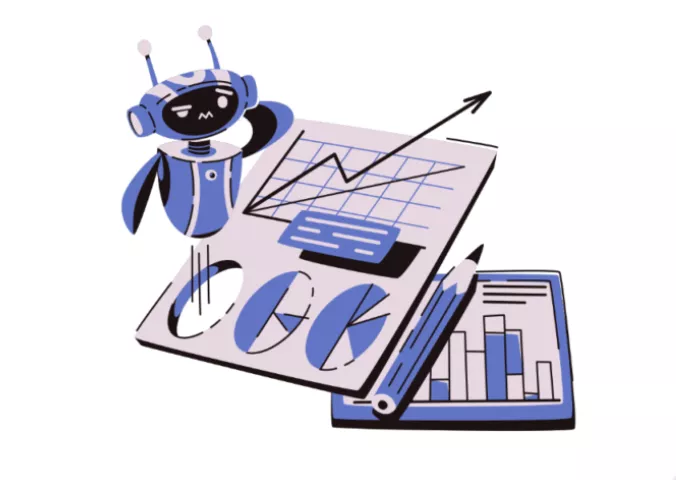
Google rolled out significant changes to AI Overviews in early 2026. If you haven’t been paying attention, your traffic patterns might look different than they did six months ago.
1) Expansion
The biggest change is expansion. AI Overviews now appear for significantly more search queries than before. Google initially limited them to simple informational queries. Now they’re showing up for commercial searches, comparison queries, and even some local searches.
This means more of your traffic is potentially coming through AI Overviews rather than traditional organic listings. The blue links you’re used to ranking for are getting pushed down the page. In many cases, they’re below the fold entirely.
2) Display
Google also changed how AI Overviews display sources. Previously, they showed minimal attribution. Now there are clearer source links within the AI-generated text. This creates more opportunities for clicks, but it also means you’re competing with multiple other sources cited in the same overview.
Read More: OpenAI Grove AI Talent Internship: Only 15 Candidates Can Apply!, Last Date to Tomorrow, January 12
3) Visual Layout
The visual layout changed too. AI Overviews are more prominent. They take up more screen space. They include images, videos, and interactive elements. This makes them harder to ignore, which means users spend more time engaging with the overview itself before deciding whether to click through.
4) Personalization
Another major update is personalization. AI Overviews now adapt based on user behavior and search history. Two people searching the same query might see different AI Overviews with different sources cited. This makes it harder to predict whether your content will be featured.
Google is now prioritizing more recent content, content with clear structure, and content that directly answers specific questions. The old SEO playbook of comprehensive guides doesn’t always win in AI Overview citations.
5) Business Information
AI Overviews for local queries now pull information from Google Business Profiles, reviews, and local content. When someone searches for local services, they might get an AI-generated summary of top options without needing to click through to individual business websites.
6) Video Content
Video content gets more visibility in AI Overviews. YouTube videos are being cited and embedded directly in overviews. If you’re creating video content, this creates new opportunities for you. But it also means users can watch your video content without visiting your channel or website.
Read More: Temple Device by Deepinder Goyal: Is Gravity & Aging Really Related?
7) Context Features
Google also added context features. AI Overviews now show when information is disputed, when sources disagree, or when there’s no clear consensus. This transparency helps users but also means your content might be presented alongside conflicting information.
8) Update Frequency
The update frequency increased. AI Overviews are being updated in real-time for breaking news and trending topics. If you publish timely content, it can get picked up and featured quickly. But this also means your content can be replaced just as fast.
9) Sponsored Ads
Google introduced sponsored content within AI Overviews. Ads are now appearing alongside or within AI-generated summaries. This creates new competition for attention and potentially reduces clicks to organic sources.
Read More: Latest ChatGPT News 2025: Will ChatGPT No Longer Give Legal Advice? Banned!
10) Multi-Modal Search
Multi-modal search also got integrated. AI Overviews now respond to searches that combine text, images, and voice. This changes how people search and what content gets surfaced. If your content isn’t optimized for different search modalities, you might miss out on AI Overview citations.
11) Ranking Factors
The ranking factors for AI Overview inclusion changed. Google is weighing factors like content freshness, author expertise, site authority, and user engagement differently than traditional organic rankings. You can rank well organically but not get cited in AI Overviews, or vice versa.
12) Analytics Integration
Analytics integration improved. Google Search Console now provides some data on AI Overview performance. You can see how often your content appears in overviews and track clicks from these features. The data isn’t perfect, but it’s better than the black box it used to be.
13) International Expansion
International expansion accelerated. AI Overviews rolled out to more countries and languages. If you operate in multiple markets, you’re now dealing with AI Overview impact across different regions, each with slightly different implementations.
These changes aren’t stopping anytime as google continues testing and refining AI Overviews. What works today might not work next month. Obviously, the SERP landscape is shifting faster than traditional algorithm updates ever did.
Read More: How To Fix ChatGPT Issue: ChatGPT Free Offer Payment Failed Error! Latest Update 2025
How Can You Optimize Your Website for AI Traffic That Actually Converts?
Optimizing your website for AI traffic requires a different approach than traditional SEO optimization. The way users arrive on your website has changed, and conversion strategies also need to reflect that shift. Let us understand how you can optimise your website for AI traffic:
1) Comprehensive Content
AI traffic users are not discovering your content for the first time. They arrive after reading an AI-generated summary that already answered part of their question. This means the opening section of your page needs to carry more weight than ever. If the first thing users see simply repeats information already shown in the AI Overview, the possibility of conversion drops significantly.
Pages that convert AI traffic well always move past surface-level explanations quickly. They provide depth, clarification, or context that the AI Overview could not fully capture. This includes edge cases, real-world implications, examples, or decision-making guidance. The faster users recognize added value, the more likely they are to stay and take action.
2) Clear Intent Alignment
Intent alignment is critical to your website being cited in AI overview because AI traffic comes from users who are further along in the search journey. Many are validating information, comparing options, or preparing to make a decision. Pages that attempt to serve multiple intents at once often underperform. Clear focus leads to clearer conversion paths.
Read More: Gemini vs ChatGPT: Best Prompts For Image Generation [2025]
3) Content Structure
Content structure also plays a larger role. AI traffic users scan aggressively. Clear headings, logical sections, and easily digestible blocks of information help users find what they need without friction. Poor structure increases bounce rates, even if the content itself is strong.
4) Clear CTA
Calls to action need to appear earlier and more naturally within the content. Waiting until the bottom of the page to introduce a conversion opportunity no longer works consistently. AI traffic users are less likely to scroll aimlessly. CTAs that align with the section the user is reading perform better than generic end-of-page prompts.
Optimising for AI traffic means ensuring that when those clicks happen, the website experience matches the user’s expectations and intent.
Websites that adapt to this shift are more likely to see AI traffic contribute meaningfully to conversions rather than inflate traffic numbers without results.
 |
Is AI Traffic Worth It?
Yes, AI traffic is worth paying attention to, but it should not be treated as a direct replacement for traditional organic traffic.
The value of AI traffic depends largely on intent. In many cases, AI Overviews satisfy the initial information need, which means fewer users click through. Those who do click are often further along in their decision process, but they represent a smaller, more selective group.

From a volume perspective, AI traffic usually delivers fewer clicks. From a quality perspective, those clicks can still matter. It tends to support conversions rather than drive them outright. It reinforces decisions, validates information, and assists users before a final action happens elsewhere on the site.
This makes AI traffic less reliable as a primary growth channel, but useful as a supporting one. Websites that treat AI traffic as incremental value rather than a core traffic source see better results, while those that optimize solely for AI visibility often see traffic increase without a corresponding lift in conversions.
Generally, AI traffic is not something to ignore, but it is also not something to chase blindly. Its role is complementary. When measured correctly and aligned with clear page intent, it can contribute to long-term growth without distorting performance metrics.
Read More: ChatGPT Age Restriction: Is ChatGPT 5.2 Restricting Under Age Users (Below 18)?
How to Track AI Traffic in Your Analytics?
Tracking AI traffic requires a slightly different approach than traditional SEO analytics. Google’s AI Overviews often drive visits without standard referral signals, so it’s important to segment and monitor traffic carefully.
Start by creating a segment in Google Analytics (or GA4) that isolates traffic from search. Look for patterns in landing pages that receive unexpected spikes or shorter sessions than typical organic traffic. AI-driven visits often appear as organic search but behave differently, lower bounce, quicker skimming, or fewer pageviews.
Use metrics like assisted conversions, scroll depth, and engagement time to evaluate AI traffic quality. Don’t rely solely on direct conversion numbers, as many AI visitors support decisions rather than convert immediately.
Over time, tracking these behaviors helps clarify which pages are performing well under AI-driven search and which may need optimization.
Monitoring trends regularly also helps anticipate changes from Google’s updates, as AI Overview placements and citations can shift quickly. Your focus is not just to count clicks, but to understand how this new type of traffic interacts with your content and contributes to overall performance.
Read More: 7 Best ChatGPT Alternatives in 2026 (Free & Paid Options Available)
What Does AI Traffic Mean for SEO Going Forward?

AI traffic signals a shift in how visibility and performance are measured in search. Rankings and click volume alone no longer tell the full story. Being cited, summarized, or referenced by Google’s AI systems now play a role in whether content gets discovered at all.
SEO going forward becomes less about capturing the first click and more about earning relevance across multiple touchpoints. Some searches will never result in a website visit, while others will send fewer but more intentional users.
This makes traffic quality and post-click behavior more important than raw sessions.
Additionally, content that performs well will be clear, structured, and focused on specific intent. Pages designed only to attract clicks without delivering added value will struggle as AI Overviews absorb surface-level information directly in the SERP.
AI traffic also reinforces the importance of authority and trust. Google’s AI systems rely heavily on credible sources, consistent expertise, and reliable signals. SEO strategies that prioritize depth, clarity, and usefulness are more likely to remain visible as search continues to evolve.
Going forward, SEO is more about aligning content with how users actually consume information in an AI-driven search environment.
Upskill with Pregrad
Pregrad is a career accelerator and upskilling platform designed to help students gain real-world skills and launch their careers before graduation.
At pregrad, you’ll learn industry‑aligned, mentor‑led programs in fields like AI/ML, data science, digital marketing, cybersecurity and more.
Learners work on hands‑on projects, attend live sessions with industry professionals, and earn recognised credentials that boost credibility with recruiters.
Pregrad also connects you with a broader career network and opportunities to accelerate your job search and career prospects.
Join pregrad today and start your career before you graduate!
AI Traffic Frequently Asked Questions And Answers
Q: What is AI traffic?
Ans: AI traffic comes from users clicking your website after interacting with Google’s AI-generated summaries, like AI Overviews, rather than traditional search results.
Q: Does AI traffic convert as well as organic traffic?
Ans: Yes, but not always. Conversion rates are often lower for informational content but can be similar or higher for transactional or comparison pages.
Q: How does AI traffic behave differently from regular search traffic?
Ans: Users arrive with context because they’ve already seen a summary of your content. This makes them more selective and goal-oriented compared to organic traffic.
Q: Should I prioritize AI traffic over traditional SEO traffic?
Ans: AI traffic is valuable but should be treated as complementary. It supports conversions rather than replacing traditional search traffic entirely.