



Some programming languages refuse to fade away, despite their age. In this guide, we’ll discover why developers still rely on these 8 old programming languages and what keeps them relevant in today’s fast-paced tech world.
The tech world is moving quite faster than we ever imagined. New programming languages pop up every year, each one with faster and smarter potentials than the last. But here’s the thing that doesn’t get talked about enough: some of the oldest programming languages are still going strong, and developers refuse to let them go.
Now the question is, Why? Well, because these programming languages work. They power critical systems, run billion-dollar industries, and solve problems that newer languages simply can’t handle. From banking systems to commerce and space missions, these old programming languages prove that age doesn’t mean outdated.
If you’re a developer, a student, an aspiring techy, or someone who’s just curious about why certain programming languages have stood the test of time, this blog is for you.
In this guide, we’ll explore 8 old programming languages that developers still use and love in 2026. You’ll learn why they’re still relevant, where they’re used today, and what makes them so hard to replace.
By the end, you’ll understand why experience sometimes beats novelty, and why these classics old programming languages aren’t going anywhere anytime soon. Are you ready?
Table of Contents
What Are Old Programming Languages?
In simple terms, old programming languages are coding languages that were created decades ago but are still actively used today. We’re talking about languages from the 1950s, 60s, 70s, and 80s that have survived multiple technology revolutions and continue to power real systems in 2026.
These programming languages are not museum pieces. They’re battle-tested tools that run critical infrastructure, manage sensitive data, and handle tasks that newer languages struggle with. Think banking systems, government databases, scientific research, and even space exploration.
What makes a programming language old is not just its age. It’s the fact that it was built in a completely different era of computing, yet it remains relevant, reliable, and surprisingly hard to replace.
While the tech world constantly chases the next big thing, these old programming languages prove that sometimes the old ways are still the best ways. They’ve earned their place through decades of proven performance.Now let’s explore why developers refuse to let them go.
Read More: 5 Highest Paying AI Jobs 2026: Prepare for Your Next Career In AI Based Jobs
Why Do Developers Still Use Old Programming Languages?

You’d think that with all the modern programming languages available today, old ones would be extinct by now. But that’s not the case.
Developers still use, learn, and build entire careers around programming languages that are older than the internet itself. So why do they stick with them? Let’s break it down.
1. They Run Critical Systems That Can’t Afford to Fail
Many old programming languages power systems that are too important to replace. We’re talking about banking infrastructure, airline reservation systems, government databases, and healthcare records. These systems process billions of transactions every day, and they work flawlessly without fail.
Replacing them would cost millions, risk massive failures, and take years to complete. So companies keep using what works. If it’s not broken, why fix it?
Read More: Christmas Day Sales 2025: Get Huge Discount of 70% on All Pregrad Courses
2. They’re Incredibly Stable and Reliable
Old programming languages have been tested, debugged, and refined for decades. Every possible error has likely been discovered and fixed. This level of stability is hard to find in newer languages that are still evolving and discovering their own bugs.
When you’re building something mission-critical, you want a language with a proven track record, not one that’s still figuring itself out.
3. There is a Massive Shortage of Developers Who Know Them
Here’s where it gets interesting. Because fewer people learn these old languages today, the developers who do know them are in extremely high demand. Companies are willing to pay top dollar for professionals who can maintain and update legacy systems.
This creates a unique opportunity. While everyone else is chasing the latest trend, you could be earning six figures working with a programming language most people have never heard of.
Read More: ChatGPT Age Restriction: Is ChatGPT 5.2 Restricting Under Age Users (Below 18)?
4. They’re Optimized for Specific Tasks
Some old programming languages were built to solve very specific problems, and they do it better than anything else. Scientific computing, data processing, system-level programming, these languages were designed from the ground up to excel in these areas.
Newer general-purpose languages can do a bit of everything, but they don’t always do it as efficiently as a specialized old programming language.
Read More: Tata Capital Pankh Scholarship: Last Date Is Today! Complete Application By Today, December 26, 2025
5. Decades of Existing Code Depend on Them
Millions of lines of code have been written in these languages. Entire industries are built on them. Rewriting all that code in a modern language isn’t just expensive, it’s often impossible.
So instead of replacing the old code, companies hire developers to maintain it, update it, and keep it running smoothly.
6. They are not Going Anywhere Anytime Soon
The reality is simple: as long as critical systems depend on these languages, developers will continue using them. And as long as there’s demand, there will be jobs, high salaries, and career opportunities.
Old programming languages are not fading away. They’re just working behind the scenes, while the new languages get all the spotlight.
8 Old Programming Languages Developers Won’t Quit
These 8 programming languages have been around for decades, yet they’re still running critical systems and keeping developers employed with impressive salaries. Let us learn about them:
1. COBOL (Common Business-Oriented Language)
COBOL was created in 1959, which makes it over 65 years old. Yet it’s still running some of the most critical systems in the world. If you’ve ever used an ATM, booked a flight, or filed for government benefits, there’s a good chance COBOL was working behind the scenes.
This language was built specifically for business applications, and it does that job incredibly well.
Why COBOL Is Still Relevant in 2026?
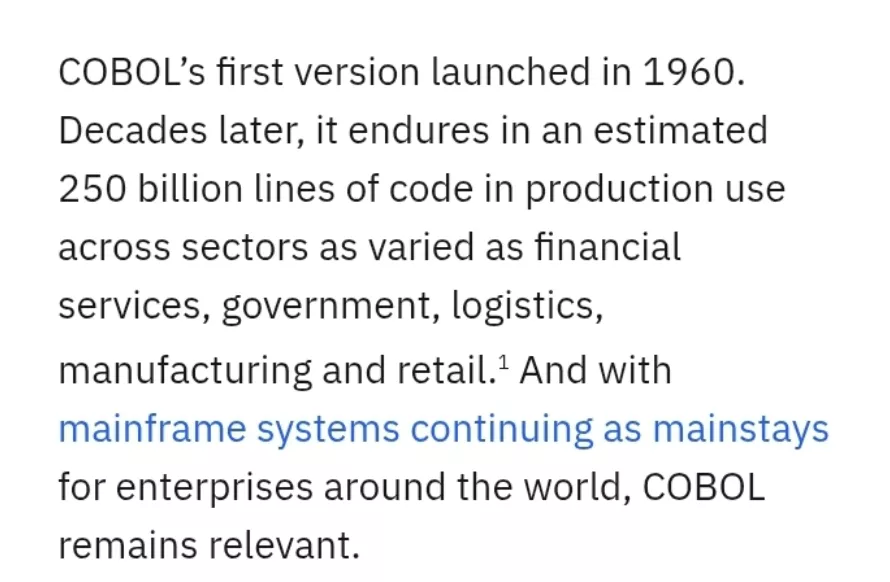 |
COBOL powers roughly 95% of ATM transactions and processes trillions of dollars in financial transactions every single day. Banks, insurance companies, and government agencies depend on it completely. The systems it runs are too massive and too important to replace.
On top of that, there’s a serious shortage of COBOL developers. Most of the programmers who built these systems are retiring, and not enough younger developers are learning the language. This means companies are desperate for anyone who can maintain their COBOL code.
Where COBOL Is Used Today?
COBOL is everywhere in finance and government. It runs banking systems, credit card processing, payroll systems, insurance claims, tax processing, and Social Security programs. Major institutions like the IRS, banks worldwide, and healthcare organizations still rely heavily on COBOL.
Key Strengths That Keep COBOL Alive
COBOL is stable, reliable, and proven. It’s been handling high-volume transactions for decades without major issues. The language is also extremely readable, which makes it easier to maintain even after all these years.
Most importantly, the sheer amount of existing COBOL code is staggering. Rewriting it all would cost billions and take decades. So instead, companies keep COBOL running and pay well for developers who know it.
2. Fortran (Formula Translation)
Fortran was born in 1957, making it one of the oldest programming languages still in active use. It was designed specifically for scientific and engineering calculations, and nearly 70 years later, it’s still the go-to language for number-crunching tasks that require serious performance.
If you’ve ever wondered how weather forecasts are made or how scientists simulate complex physics problems, Fortran is probably involved.
Why Fortran Is Still Relevant in 2026?
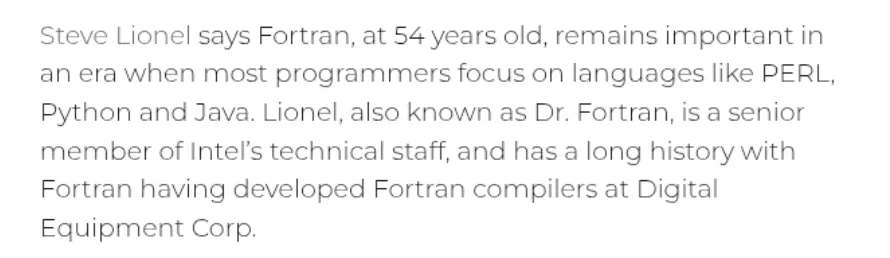 |
Fortran is incredibly fast when it comes to mathematical computations. It was built for performance from day one, and decades of optimization have made it nearly unbeatable for certain types of calculations.
Scientists and engineers continue to use Fortran because it outperforms most modern languages in computational speed. When you’re running simulations that take days or weeks to complete, even small performance differences matter enormously.
Where Fortran Is Used Today?
Fortran dominates scientific computing, weather prediction, climate modeling, and aerospace engineering. It’s used in supercomputers, research labs, universities, and space agencies like NASA. Physics simulations, fluid dynamics, and computational chemistry all rely heavily on Fortran.
If a project involves massive numerical calculations or high-performance computing, Fortran is likely in the picture.
Key Strengths That Keep Fortran Alive
Fortran’s biggest strength is raw computational speed. It’s also battle-tested in the most demanding scientific environments imaginable. The language has evolved over the years with modern features, but it maintains backward compatibility with decades-old code.
There’s also a massive library of scientific code written in Fortran. Rewriting these proven algorithms in another language would be expensive, time-consuming, and risky. So researchers keep using what works.
3. C Language
C was created in 1972, and it’s one of the most influential programming languages ever made. It’s the foundation that many modern languages are built on, and it’s still widely used today for systems that need direct hardware control and maximum performance.
If you use a computer, smartphone, or any electronic device, C is probably running somewhere inside it.
Why C Is Still Relevant in 2026?
 |
C gives developers direct control over hardware and memory, which makes it perfect for building operating systems, embedded systems, and performance-critical applications. It’s fast, efficient, and doesn’t waste resources.
Most operating systems, including Windows, Linux, and macOS, are written largely in C. Device drivers, firmware, and embedded systems in everything from cars to medical devices rely on C.
Where C Is Used Today?
C is everywhere in system-level programming. It powers operating systems, embedded systems in IoT devices, automotive software, robotics, game engines, and database management systems. Major companies like Microsoft, Apple, and Google use C extensively.
If something needs to run fast, use minimal resources, or interact directly with hardware, C is usually the language of choice.
Read More: AICTE Python Full Stack Developer Internship: AICTE Paid Internship Opportunity [Latest 2025]
Key Strengths That Keep C Alive
C is incredibly portable. Code written in C can run on almost any platform with minimal changes. It’s also extremely efficient, which matters when you’re working with limited hardware resources or need maximum speed.
The language is simple and powerful. It doesn’t hide what’s happening under the hood, which gives experienced developers precise control. Plus, decades of tools, libraries, and documentation make C development mature and well-supported.
4. Python Language

Python was created in 1991 by Guido van Rossum as a language that prioritized readability and simplicity. While it’s younger than the other languages on this list, Python has proven its staying power over three decades and shows no signs of slowing down.
What started as a scripting language has become one of the most widely used programming languages in the world.
Why Python Is Still Relevant in 2026?
 |
Python is everywhere. It dominates data science, machine learning, artificial intelligence, web development, automation, and scientific computing. Its simple syntax makes it accessible to beginners, while its powerful libraries make it indispensable to professionals.
Companies across every industry use Python for everything from quick scripts to enterprise applications. The demand for Python developers remains consistently high, and the language continues to evolve with modern technology needs.
Where Python Is Used Today?
Python powers AI and machine learning frameworks like TensorFlow and PyTorch. It’s used in web development with frameworks like Django and Flask. Data scientists rely on Python for analysis and visualization with libraries like Pandas and NumPy.
Tech giants like Google, Netflix, Instagram, Spotify, and NASA use Python extensively. It’s also the language of choice for automation, DevOps, cybersecurity, and academic research.
Key Strengths That Keep Python Alive
Python’s readability makes code easy to write and maintain. Its massive ecosystem of libraries and frameworks means you can build almost anything without starting from scratch.
The language is versatile enough to handle web apps, data analysis, automation, AI, and more. Python’s active community continuously develops new tools and keeps the language relevant as technology evolves.
5. Visual Basic Language
Visual Basic was introduced by Microsoft in 1991 as a way to make Windows application development accessible to everyone. It combined the BASIC programming language with a visual interface builder, allowing developers to create Windows programs by dragging and dropping components.
Visual Basic 6, released in 1998, became incredibly popular and spawned millions of business applications that are still running today.
Why Visual Basic Is Still Relevant in 2026
 |
Thousands of businesses still rely on applications built in Visual Basic 6. These programs handle inventory management, customer databases, accounting systems, and countless other critical business functions.
Many companies can’t afford to rewrite these applications, and they still work perfectly fine. So they keep them running and hire developers who can maintain and update the code when needed.
Where Visual Basic Is Used Today?
Visual Basic powers legacy business applications across industries. You’ll find it in small to medium-sized businesses, manufacturing companies, retail systems, and internal corporate tools.
Many government agencies and educational institutions also run Visual Basic applications.
While Microsoft officially ended support years ago, the applications themselves continue running on modern Windows systems.
Key Strengths That Keep Visual Basic Alive
Visual Basic made programming accessible. It was easy to learn, quick to develop with, and perfect for building Windows desktop applications. This simplicity led to its massive adoption in the business world.
The sheer volume of existing Visual Basic applications means there’s still steady demand for developers who know it. These are not glamorous projects, but they’re stable, necessary, and often well-paid maintenance work.
6. Pascal Language
Pascal was created in 1970 by Niklaus Wirth as a language designed to teach good programming practices. It emphasized clear structure, readability, and disciplined coding habits. What started as an educational tool became a serious development language used in both academia and industry.
Turbo Pascal and later Delphi brought Pascal into the commercial world, where it powered countless desktop applications throughout the 1980s and 1990s.
Read More: Grab A Chance For Lateral Entry In B Tech in Government Colleges [2025]: A Complete Guide
Why Pascal Is Still Relevant in 2026?
Pascal is still widely used in education to teach programming fundamentals. Its clear syntax and strong typing help students understand core concepts without getting lost in complexity.
Beyond education, Delphi (Object Pascal) continues to power legacy enterprise applications. Many businesses built critical systems in Delphi during its peak, and those systems are still running smoothly today.
Where Pascal Is Used Today?
Pascal remains popular in computer science education worldwide. Universities use it to teach algorithms, data structures, and programming principles.
In the business world, Delphi applications are still common in finance, healthcare, manufacturing, and enterprise resource planning systems. Some companies continue developing new Delphi applications because their entire infrastructure is built around it.
Key Strengths That Keep Pascal Alive
Pascal’s readability makes it excellent for learning and maintaining code. Its strong typing catches errors early, and its structured approach encourages clean, organized programming.
For legacy Delphi applications, the language offers fast compilation, native Windows integration, and mature libraries. Companies with existing Delphi codebases find it easier and cheaper to maintain what they have rather than start over.
Read More: 5 Free Internships Available For College Students In December 2025: Latest Opportunities Available
7. Perl Language

Perl was created in 1987 by Larry Wall as a powerful text-processing language. It quickly became the go-to tool for system administrators, web developers, and anyone who needed to manipulate text, automate tasks, or process data efficiently.
Perl dominated web development in the 1990s and early 2000s before languages like PHP and Python rose to prominence. But it never truly disappeared.
Why Perl Is Still Relevant in 2026?
Perl excels at text processing and pattern matching. Its regular expression support is legendary, and for certain text manipulation tasks, Perl remains faster and more efficient than newer alternatives.
System administrators still rely on Perl for automation scripts, log processing, and system maintenance. Many critical infrastructure tools and scripts written decades ago are still running in Perl, and they work flawlessly.
Where Perl Is Used Today?
Perl is widely used in system administration, network programming, bioinformatics, and legacy web applications. Major companies in finance, telecommunications, and technology still maintain Perl codebases.
It’s also common in academic and scientific computing, where researchers use it for data processing and analysis. The bioinformatics field, in particular, has extensive Perl libraries and tools that continue to be actively used.
Key Strengths That Keep Perl Alive
Perl’s text processing capabilities are unmatched. It can handle complex pattern matching and string manipulation with minimal code. The language is also incredibly flexible, giving developers multiple ways to solve problems.
CPAN, Perl’s comprehensive module repository, contains thousands of pre-built solutions for virtually any task. This mature ecosystem means developers can accomplish complex tasks quickly without reinventing the wheel.
8. Ada

Ada was created in the 1980s by the U.S. Department of Defense specifically for building safety-critical and mission-critical systems. It was named after Ada Lovelace, the world’s first computer programmer, and designed with reliability, safety, and maintainability as top priorities.
Ada is not trendy, but when failure is not an option, Ada is often the language of choice.
Why Ada Is Still Relevant in 2026?
Ada is built for systems where bugs can cost lives. Its strong typing, compile-time error detection, and built-in safety features make it incredibly reliable. The language catches errors before code ever runs, which is critical in high-stakes environments.
Industries that deal with human safety, national security, or multi-million dollar equipment can’t afford to take risks. Ada’s track record of reliability makes it worth the investment.
Where Ada Is Used Today?
Ada dominates aerospace, defense, aviation, and transportation systems. It’s used in aircraft control systems, air traffic control, military systems, railway signaling, spacecraft, and medical devices.
Major organizations like NASA, the European Space Agency, Boeing, Airbus, and defense contractors worldwide use Ada for projects where reliability is non-negotiable.
Key Strengths That Keep Ada Alive
Ada’s biggest strength is safety. The language prevents entire categories of bugs that plague other languages. Memory errors, type mismatches, and logic flaws are caught during compilation, not during flight.
Ada also has excellent support for real-time systems and concurrent programming. When you need precise timing control and multiple processes running simultaneously without interference, Ada delivers.
The language may not be popular, but in environments where lives depend on code working correctly, Ada remains irreplaceable.
Should You Learn Old Programming Languages in 2026?

This is a fair question. With so many modern programming languages available, why would you invest time learning something from the 1950s, 60s, or 70s?
The short answer is that it totally depends on your career goals and whatever you want to achieve.
If you’re looking for job security, high pay, and less competition, learning an old programming language might be one of the smartest career moves you can make. If you want to work on cutting-edge projects with the latest frameworks, you might be better off with modern languages.
Let us break down why and when learning old programming languages makes sense.
When Should You Learn Old Programming Languages?

1. You Want High-Paying, Stable Jobs
Old programming languages offer something rare in tech: job security. Companies desperately need developers who can maintain legacy systems, and they’re willing to pay premium salaries for this expertise.
While your friends compete for trendy JavaScript positions, you could be earning six figures maintaining COBOL systems with far less competition.
2. You’re Interested in Specific Industries
If you want to work in finance, aerospace, government, scientific research, or healthcare, old programming languages are often required. These industries rely heavily on legacy systems and aren’t switching anytime soon.
Learning old programming languages like COBOL, Fortran, or Ada opens doors in these specialized fields that modern languages simply can’t access.
3. You Want to Understand How Computers Really Work
Languages like C teach you what’s actually happening under the hood. This deep understanding makes you a better programmer overall, even when working with modern languages.
Many senior developers credit their success to learning these foundational languages early in their careers.
4. You’re Building a Niche Career
Specializing in an old programming language creates a unique position in the job market. You become one of the few people who can solve specific problems, which gives you leverage in salary negotiations and job opportunities. Niche skills often pay better than general ones.
When Modern Programming Languages Might Be Better?
If you’re just starting out, modern languages like JavaScript might be easier entry points. They have larger communities, more beginner resources, and faster feedback loops for learning.
If you want startup or tech company jobs, most startups use modern stacks. Old programming languages are less common in these environments.
If you prefer working on new projects, modern languages dominate greenfield development. Old languages are mostly about maintenance and updates.
Read More: Google Step Is Now Google ASDI: Check Official Updates On Google Step 2026
The Future of Old Programming Languages

If you’re wondering whether old programming languages will still be around in 5, 10, or even 20 years, the answer is simple: yes, they will.
These old programming languages aren’t going anywhere because the systems they power aren’t going anywhere either. Banks won’t rewrite their entire infrastructure. Governments won’t replace decades of working code. Scientific institutions won’t abandon tools that have delivered results for half a century.
The cost, risk, and time required to replace these systems is simply too high, hence practically the traditional environment will not be wiped out in the coming days.
Legacy Systems Are Not Disappearing
The reality is that legacy systems will continue running for decades. Every year, companies talk about modernizing their tech stack, but when it comes to mission-critical systems, they stick with what works.
COBOL will keep processing financial transactions. Fortran will keep running scientific simulations. C will remain the backbone of operating systems and embedded devices.
These old programming languages have proven themselves reliable, and reliability is what matters most in critical infrastructure.
1. The Developer Gap Is Growing
Here’s what makes the future even more interesting: fewer developers are learning these old languages, but the demand for them isn’t decreasing.
As older developers retire, the shortage becomes more severe. Companies will compete harder for the remaining experts, which means higher salaries and better opportunities for those who know these languages.
This creates a long-term career advantage. While everyone else chases the latest framework, you could be building a stable, high-paying career in a field with minimal competition.
2. Modern Tools Are Making Old Languages More Accessible
The good news is that learning old programming languages is getting easier. Modern development tools, online courses, documentation, and communities are making these languages more accessible than ever before.
You don’t need to learn these languages the hard way anymore. Resources are available, and the barrier to entry is lower than it’s ever been.
Read More: ChatGPT Age Restriction: Is ChatGPT 5.2 Restricting Under Age Users (Below 18)?
3. Hybrid Careers Are Emerging
The future also includes hybrid roles where developers work with both old and new technologies. Companies need people who can maintain legacy systems while also integrating modern tools and APIs.
If you understand both worlds, you become incredibly valuable. You can bridge the gap between old infrastructure and new innovation, which is exactly what many organizations need.
4. Old Languages Will Evolve, Not Die
Some of these old programming languages continue to receive updates and improvements. Modern features get added while maintaining backward compatibility.
This means old programming languages adapt without losing their core strengths. They won’t disappear. They’ll just keep doing what they’ve always done, which is running behind the scenes quietly and efficiently.
Bottom Line
Old programming languages have a future because they have a present. As long as critical systems depend on them, developers who know them will have job security, high salaries, and steady demand.
The tech world moves fast, but infrastructure moves slowly. And that’s exactly why these old languages aren’t going anywhere anytime soon.
Upskill With Pregrad🚀
The demand for skilled Old programming languages experts are growing fast across every industry, and whether you want to master modern languages or specialize in the classics we’ve discussed, having the right foundation matters.
Pregrad helps you become job-ready by giving you the skills, certifications, and hands-on experience that employers actually want. If you’re a student, fresher, or career switcher looking to break into tech or level up your programming skills, Pregrad’s industry-backed programs are designed for you.
Pregrad offers courses in AI/ML, Data Science, Full Stack Development, Java Spring Boot, DevOps, Cloud Computing, App Development, Digital Marketing, Business Analytics, and more. You’ll learn through real-world projects, gain globally recognized certifications from giants like IBM, Microsoft, Meta, and Cisco, and get expert mentorship from industry professionals.

Along with structured learning, you also get career support, placement assistance, networking opportunities with recruiters, resume and LinkedIn guidance, and access to internship and job opportunities at 300+ companies.
If you’re interested in learning Python, C, or any programming language, Pregrad equips you with the tools and confidence to succeed in the tech industry.
Enroll now and take your first step toward a high-paying programming career.
Old Programming Languages FAQs
Q1. Are old programming languages still worth learning in 2026?
Ans: Yes. Old programming languages offer high-paying jobs, less competition, and strong job security. Companies desperately need developers who can maintain legacy systems, and they’re willing to pay premium salaries for this expertise. If you want stability and specialization, learning an old programming language is a smart career move.
Q2. Can I get a job if I only know old programming languages?
Ans: Absolutely. Many companies specifically hire developers who know languages like COBOL, Fortran, C, or Ada. Banks, government agencies, aerospace companies, and scientific institutions actively seek professionals with these skills. The demand is high, and the pay is competitive.
Q3. Do I need a computer science degree to learn old programming languages?
Ans: No. While a degree can help, what matters most is your ability to understand the language and apply it to real problems. Many developers learn these languages through online courses, documentation, and hands-on practice. Skills and experience often matter more than formal education.
Q4. Which old programming language should I learn first?
Ans: It depends on your career goals. If you’re interested in finance or government work, start with COBOL. For scientific computing, choose Fortran. If you want to understand system-level programming, go with C. If aerospace or safety-critical systems appeal to you, learn Ada. Pick the language that aligns with the industry you want to work in.